



High-precision
Normally we implement addition, subtraction, multiplication, and division directly using +-*/, but when the numbers grow to lengths of 100 or 1000, the storage range of int and long long is no longer sufficient; at this point it is time to use high-precision.
1. High-precision addition A+B
1.1 How it works
First is addition between large numbers, which can be simulated by following the normal steps of addition. For example, see the figure below:
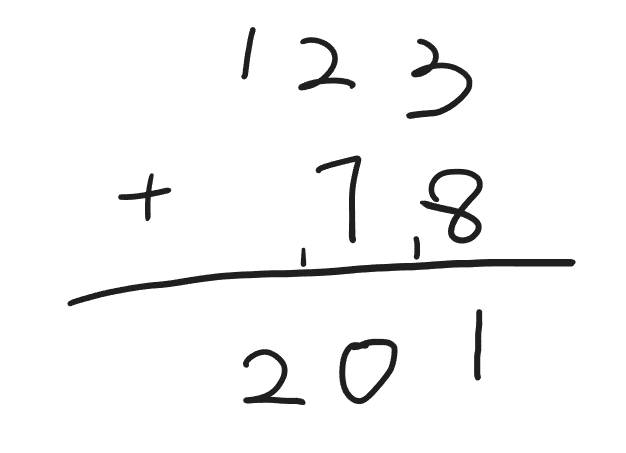
You can see that addition is performed from right to left, so we can reverse the obtained digits to invert their order, and after computation output in forward order.
1.2 Examples
Reference code:
void solve(){ //... for(int i=0,c=0;i<max(a.length(),b.length()) || c;i++){ int t1=0,t2=0; if(i<a.length()) t1 = a[i]-'0'; if(i<b.length()) t2 = b[i]-'0'; int t = t1 + t2 + c; c = t / 10;t %= 10; ans.push_back(t+'0'); } //...}2. High-precision subtraction A-B
2.1 How it works
Next is subtraction between large numbers. The method is still similar to high-precision addition; the difference is that due to the relative sizes of A and B, the result may be negative. In that case we can write A-B = -(B-A) to keep the subtraction result non-negative.
P.S. Note that because this is subtraction, leading zeros may appear; remember to remove them before output.
2.2 Examples
Reference code:
bool comp(){ if(a.length()!=b.length()) return a.length()>b.length(); for(int i=a.length()-1;~i;i--) if(a[i]!=b[i]) return a[i]>b[i]; return true;}void solve(){ //... if(!comp()) p = 1,swap(a,b); for(int i=0,c=0;i<a.length();i++){ int t1=0,t2=0; if(i<a.length()) t1 = a[i]-'0'; if(i<b.length()) t2 = b[i]-'0'; int t = t1 - t2 + c; if(t < 0) c=-1,t+=10; else c = 0; ans.push_back(t+'0'); }reverse(ans.begin(),ans.end()); if(p) cout<<"-";p=-1; while(++p<ans.length() && ans[p]=='0'); ans = ans.substr(min(p,(int)(ans.length()-1)),max((int)(ans.length()-p),1)); //...}3. High-precision multiplication A*b
3.1 How it works
Multiplication between a large number and a small number is relatively straightforward: use a variable to record the carry of the products of each digit of A with b, and obtain the result for each digit in sequence.
P.S. Note that when the large number is 0, the product may have leading zeros; be sure to remove them.
3.2 Examples
Reference code:
void solve(){ for(int i=0,c=0;i<a.length() || c;i++){ int t1 = 0; if(i<a.length()) t1 = a[i]-'0'; int t = t1 * b + c; ans.push_back(t%10+'0');c = t / 10; }}4. High-precision division A/b
4.1 How it works
Similar to the multiplication of large numbers by small numbers, the division of a large number by a small number is also straightforward. You can divide the leading part of the large number from left to right by b, recording the quotient and remainder of each prefix with c/b.
P.S. Note that in earlier stages the dividend may be too small, causing leading zeros; remember to remove them before output.
4.2 Examples
Reference code:
void solve(){ for(int i=0;i<a.length();i++){ int t1 = a[i]-'0'; int t = t1 + 10 * c; ans.push_back(t/b + '0'); c = t%b; }int p = -1;while(++p<ans.length() && ans[p]=='0'); ans = ans.substr(min(p,(int)(ans.length()-1)),max(1,(int)(ans.length()-p)));}If this article helped you, please share it with others!
Some information may be outdated