



1. 前缀和
1.1 算法原理
所谓前缀和,就是记录下前方所有数据之和,当所需中间数据时,可以通过o(1)的时间复杂度将数据求出。
- 一维数组前缀和
求出1~i的所有项之和。
由于当运算到第
i位时,前i-1位已经运算完成,故a[i] = a[i] + a[i-1]。
- 当需要
[l,r]之和时,可以通过a[r]-a[l-1]求出
- 二维数组前缀和
求出左上端点、右下端点分别为(1,1),(i,j)的长方形内的数据之和
当运算到
(i,j)时,前i-1排、第i排前j-1位均已运算完成,故a[i][j] = a[i][j]+a[i-1][j]+a[i-1]-a[i-1][j-1]。
- 当需要左上端点、右下端点分别为
(x1,y1),(x2,y2)的长方形内的数据之和时,a[x2][y2]-a[x2][y1-1]-a[x1-1][y2]+a[x1-1][y1-1]
1.2 例题
参考代码:
void solve(){ cin>>n>>m; for(int i=1;i<=n;i++) cin>>a[i],a[i]+=a[i-1]; while(m--){ cin>>l>>r; cout<<a[r]-a[l-1]<<endl; }}参考代码:
void solve(){ cin>>n>>m>>q; for(int i=1;i<=n;i++) for(int j=1;j<=m;j++) cin>>a[i][j],a[i][j]+=a[i-1][j]+a[i][j-1]-a[i-1][j-1]; while(q--){ cin>>x1>>y1>>x2>>y2; cout<<a[x2][y2]-a[x2][y1-1]-a[x1-1][y2]+a[x1-1][y1-1]<<endl; }}2. 差分
2.1 算法原理
所谓差分,就是记录每位数据与前一位数据之间的差,当需要对区间进行操作时,可以通过o(1)的时间复杂度完成操作。
同时我们可以发现差分数组的前缀和就是原数组。
- 一维数组差分
求出与前一项之差。当需要对[l,r]范围内的数进行加减操作时时,可以通过b[l]+c、b[r+1]-c实现
- 二维数组差分
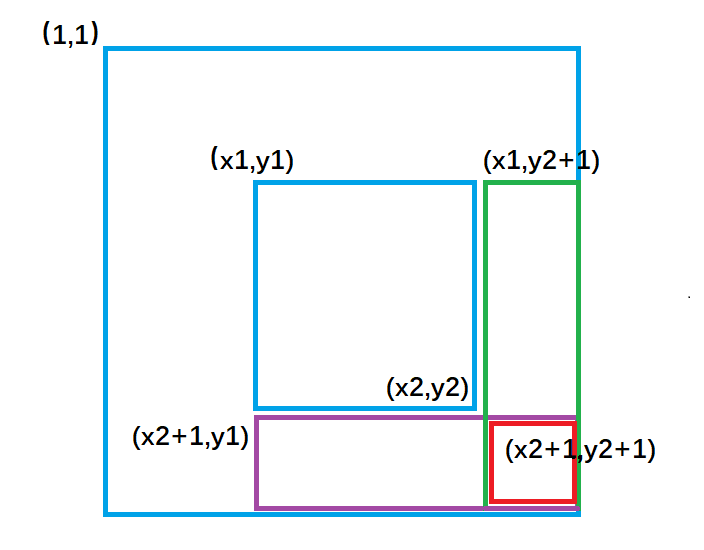
二维差分数组的构建可以由其前缀和的结果来逆向考虑。
当对
(x1,y1),(x2,y2)的长方形内的数据都加上c时,即a[x1,y1]~a[x2,y2]均加c。故当b[x1,y1]+=c,b[x1,y2+1]-=c,b[x2+1,y1]-=c,b[x2+1,y2+1]+=c,即可实现仅区间内的数据加c。
当构建差分数组时,可以发现其为对长宽为1的长方形加
a[i,j],由此实现二维差分数组。
2.2 例题
参考代码:
void solve(){ for(int i=1;i<=n;i++) cin>>a[i]; for(int i=1;i<=n;i++) b[i] = a[i]-a[i-1]; while(m--){ cin>>l>>r>>c; b[l]+=c;b[r+1]-=c; }for(int i=1,t=0;i<=n;i++) t+=b[i],cout<<t<<' ';}参考代码:
void add(){ b[x1][y1] += c;b[x1][y2+1] -=c; b[x2+1][y1] -= c;b[x2+1][y2+1] +=c;}void solve(){ for(int i=1;i<=n;i++) for(int j=1;j<=m;j++) cin>>a[i][j],x1=x2=i,y1=y2=j,c=a[i][j],add(); while(q--){ cin>>x1>>y1>>x2>>y2>>c; add(); } for(int i=1;i<=n;i++){ for(int j=1;j<=m;j++){ a[i][j] = b[i][j] + a[i-1][j]+a[i][j-1]-a[i-1][j-1]; cout<<a[i][j]<<' '; }cout<<endl; }}3. 双指针
3.1 算法原理
双指针问题主要是依据序列性质,使用指针j对有效查询范围进行记录,从而减少运算的时间复杂度。
双指针问题主要分为下面两类:
- 在一个序列中,两个指针维护一段区间。
- 在两个序列中,维护某种次序
基本模板(来自AcWing)
void solve(){ for(int i=0,j=0;i<n;i++){ while(j<i && check(i,j)) j++;
//具体问题逻辑 }}3.2 例题
解决逻辑:设置cnt数组记录[j,i]区间内的数据出现次数,当i指向数a[i]已经出现时,让j向前移动,直到[j,i-1]中a[i]出现次数为0。过程中记录长度。
参考代码:
void solve(){ for(int i=1,j=1;i<=n;i++){ if(cnt[a[i]]){ while(cnt[a[i]]) cnt[a[j++]]--; } cnt[a[i]]++; ans = max(i-j+1,ans); }cout<<ans<<endl;}解决逻辑:由序列升序,可以直到当a[i]+a[j]>x时,a[i+1]+a[j]必然大于x。所以可以使用j来记录需要判断的边界,从而减少搜索时间。
参考代码:
void solve(){ for(int i=0,j=m-1;i<n,j>0;i++){ while(a[i]+b[j]>x) j--; if(a[i]+b[j]==x){ cout<<i<<' '<<j<<endl; return 0; } }}解决逻辑:由子串是在母串中按次序出现,我们可以按位寻找子串每位在母串中对应的位置。
参考代码:
void solve(){ for(int i=0,j=0;i<n && j<m;i++,j++){ while(a[i] != b[j] && j<m) j++; if(i==n-1 && j < m) {cout<<"Yes"<<endl;return 0;} }cout<<"No"<<endl;}1. Prefix Sum
1.1 Algorithm Principle
The prefix sum is defined as recording the sum of all data to the left; when intermediate data is needed, it can be obtained in O(1) time.
- One-dimensional prefix sum
The sum of all terms from 1 to i.
Since when processing the i-th position, the first i-1 positions have already been computed, thus a[i] = a[i] + a[i-1].
- When the sum of [l,r] is needed, it can be obtained by a[r]-a[l-1]
- Two-dimensional prefix sum
Find the sum of data within the rectangle whose top-left corner is (1,1) and bottom-right corner is (i,j)
When processing (i,j), the first i-1 rows and the first j-1 elements in row i have been computed, so a[i][j] = a[i][j] + a[i-1][j] + a[i][j-1] - a[i-1][j-1].
- When the sum of data inside the rectangle with top-left corner (x1,y1) and bottom-right corner (x2,y2) is needed, it is a[x2][y2]-a[x2][y1-1]-a[x1-1][y2]+a[x1-1][y1-1]
1.2 Examples
Reference code:
void solve(){ cin>>n>>m; for(int i=1;i<=n;i++) cin>>a[i],a[i]+=a[i-1]; while(m--){ cin>>l>>r; cout<<a[r]-a[l-1]<<endl; }}Reference code:
void solve(){ cin>>n>>m>>q; for(int i=1;i<=n;i++) for(int j=1;j<=m;j++) cin>>a[i][j],a[i][j]+=a[i-1][j]+a[i][j-1]-a[i-1][j-1]; while(q--){ cin>>x1>>y1>>x2>>y2; cout<<a[x2][y2]-a[x2][y1-1]-a[x1-1][y2]+a[x1-1][y1-1]<<endl; }}2. Difference
2.1 Algorithm Principle
The so-called difference array records the difference between each value and the previous value; when needing to operate on a range, the operation can be completed in O(1) time.
At the same time, we can see that the prefix sum of the difference array is the original array.
- One-dimensional difference
Compute the difference from the previous term. When needing to add or subtract to numbers in the range [l,r], it can be achieved by b[l]+=c and b[r+1]-=c
- Two-dimensional difference
The construction of the two-dimensional difference array can be reasoned backwards from its prefix sum.
When all data inside the rectangle defined by (x1,y1) and (x2,y2) is increased by c, i.e., a[x1,y1]~a[x2,y2] are all increased by c. Therefore by doing b[x1,y1]+=c, b[x1,y2+1]-=c, b[x2+1,y1]-=c, b[x2+1,y2+1]+=c, we can achieve adding c only to the region.
When constructing the difference array, one can see that it is adding a rectangle of width and height 1 with a[i,j], thus realizing a two-dimensional difference array.
2.2 Examples
Reference code:
void solve(){ for(int i=1;i<=n;i++) cin>>a[i]; for(int i=1;i<=n;i++) b[i] = a[i]-a[i-1]; while(m--){ cin>>l>>r>>c; b[l]+=c;b[r+1]-=c; }for(int i=1,t=0;i<=n;i++) t+=b[i],cout<<t<<' ';}Reference code:
void add(){ b[x1][y1] += c;b[x1][y2+1] -=c; b[x2+1][y1] -= c;b[x2+1][y2+1] +=c;}void solve(){ for(int i=1;i<=n;i++) for(int j=1;j<=m;j++) cin>>a[i][j],x1=x2=i,y1=y2=j,c=a[i][j],add(); while(q--){ cin>>x1>>y1>>x2>>y2>>c; add(); } for(int i=1;i<=n;i++){ for(int j=1;j<=m;j++){ a[i][j] = b[i][j] + a[i-1][j]+a[i][j-1]-a[i-1][j-1]; cout<<a[i][j]<<' '; }cout<<endl; }}3. Two Pointers
3.1 Algorithm Principle
Two-pointer problems are mainly based on the properties of the sequence, using pointer j to record the valid query range, thereby reducing the time complexity of computations.
Two-pointer problems are mainly divided into the following two categories:
- In a single sequence, two pointers maintain a segment.
- In two sequences, maintain some order
Basic template (from AcWing)
void solve(){ for(int i=0,j=0;i<n;i++){ while(j<i && check(i,j)) j++;
// Specific problem logic }}3.2 Examples
Solution idea: set a cnt array to record the occurrence count of data in the [j,i] interval; when i points to a[i] that has already appeared, move j forward until the count of a[i] in [j,i-1] becomes 0. Track the length along the way.
Reference code:
void solve(){ for(int i=1,j=1;i<=n;i++){ if(cnt[a[i]]){ while(cnt[a[i]]) cnt[a[j++]]--; } cnt[a[i]]++; ans = max(i-j+1,ans); }cout<<ans<<endl;}Solution idea: Since the sequence is sorted in ascending order, you can stop when a[i]+a[j]>x; then a[i+1]+a[j] will also be greater than x. Therefore you can use j to record the boundary that needs to be checked, reducing search time.
Reference code:
void solve(){ for(int i=0,j=m-1;i<n,j>0;i++){ while(a[i]+b[j]>x) j--; if(a[i]+b[j]==x){ cout<<i<<' '<<j<<endl; return 0; } }}Solution idea: Since the substring appears in the source string in order, we can locate each character of the substring in the source string sequentially.
Reference code:
void solve(){ for(int i=0,j=0;i<n && j<m;i++,j++){ while(a[i] != b[j] && j<m) j++; if(i==n-1 && j < m) {cout<<"Yes"<<endl;return 0;} }cout<<"No"<<endl;}1. 累積和
1.1 アルゴリズムの原理
いわゆる累積和とは、前方のすべてのデータの和を記録しておくことを指し、所要の中間データを得る際には、o(1)の時間計算量でデータを求めることができる。
- 一次元配列の累積和
1からiまでのすべての項の和を求める。
当運算到第
i位時、前i-1位はすでに運算完了しているため、a[i] = a[i] + a[i-1]。当需要
[l,r]の和時は、a[r]-a[l-1]で求められる
- 二次元配列の累積和
左上端点、右下端点がそれぞれ(1,1)、(i,j)の長方形内のデータの和を求める
i,jへ到達した時、前
i-1排目と、第i排目の前j-1位はすべて計算済みであるため、a[i][j] = a[i][j]+a[i-1][j]+a[i-1]-a[i-1][j-1]。
- 左上端点、右下端点がそれぞれ
(x1,y1)、(x2,y2)の長方形内のデータの和は、a[x2][y2]-a[x2][y1-1]-a[x1-1][y2]+a[x1-1][y1-1]
1.2 例題
参考コード:
void solve(){ cin>>n>>m; for(int i=1;i<=n;i++) cin>>a[i],a[i]+=a[i-1]; while(m--){ cin>>l>>r; cout<<a[r]-a[l-1]<<endl; }}参考コード:
void solve(){ cin>>n>>m>>q; for(int i=1;i<=n;i++) for(int j=1;j<=m;j++) cin>>a[i][j],a[i][j]+=a[i-1][j]+a[i][j-1]-a[i-1][j-1]; while(q--){ cin>>x1>>y1>>x2>>y2; cout<<a[x2][y2]-a[x2][y1-1]-a[x1-1][y2]+a[x1-1][y1-1]<<endl; }}2. 差分
2.1 アルゴリズムの原理
差分とは、各データと前のデータとの差を記録することで、区間に対して操作を行う際にo(1)の時間計算量で処理を完了できる。
また、差分配列の前縁の和は元の配列そのものになることが分かる。
- 一次元配列の差分
前項との差を求める。
[l,r]範囲の数を加減する必要がある場合、b[l]+=c、b[r+1]-=cで実現
- 二次元配列の差分
二次元差分配列の構築は、その前縁和の結果から逆算して考えることができる。
(x1,y1)、(x2,y2)の長方形内のデータをすべてc加えるとき、すなわちa[x1,y1]~a[x2,y2]がすべてcとなるようにします。したがってb[x1,y1]+=c、b[x1,y2+1]-=c、b[x2+1,y1]-=c、b[x2+1,y2+1]+=cとすれば、区間内のデータのみを加えることができます。
差分配列を構築する際、それは長さ1の長方形に対して
a[i,j]を加えることになるため、2次元差分配列を実現できる。
2.2 例题
参考コード:
void solve(){ for(int i=1;i<=n;i++) cin>>a[i]; for(int i=1;i<=n;i++) b[i] = a[i]-a[i-1]; while(m--){ cin>>l>>r>>c; b[l]+=c;b[r+1]-=c; }for(int i=1,t=0;i<=n;i++) t+=b[i],cout<<t<<' ';}参考コード:
void add(){ b[x1][y1] += c;b[x1][y2+1] -=c; b[x2+1][y1] -= c;b[x2+1][y2+1] +=c;}void solve(){ for(int i=1;i<=n;i++) for(int j=1;j<=m;j++) cin>>a[i][j],x1=x2=i,y1=y2=j,c=a[i][j],add(); while(q--){ cin>>x1>>y1>>x2>>y2>>c; add(); } for(int i=1;i<=n;i++){ for(int j=1;j<=m;j++){ a[i][j] = b[i][j] + a[i-1][j]+a[i][j-1]-a[i-1][j-1]; cout<<a[i][j]<<' '; }cout<<endl; }}3. 双指针
3.1 アルゴリズムの原理
ダブルポインタ問題は、列の性質に基づき、有効なクエリ範囲を指針 j で記録することにより、計算時間の複雑さを低減します。
ダブルポインタ問題は主に以下の2つに分類されます。
- 一つの列で、二つのポインタが区間を維持する。
- 二つの列で、ある種の順序を維持する
基本テンプレート(AcWing より)
void solve(){ for(int i=0,j=0;i<n;i++){ while(j<i && check(i,j)) j++;
//具体的な問題ロジック }}3.2 例题
解法の逻辑:cnt 配列を用いて [j,i] 区間内のデータの出現回数を記録します。i が a[i] をすでに出現させている場合、[j,i-1] 内で a[i] の出現回数が0になるまで j を前方へ動かします。長さを途中で記録します。
void solve(){ for(int i=1,j=1;i<=n;i++){ if(cnt[a[i]]){ while(cnt[a[i]]) cnt[a[j++]]--; } cnt[a[i]]++; ans = max(i-j+1,ans); }cout<<ans<<endl;}解法の逻辑:数列は昇順なので、a[i]+a[j] > x となると、a[i+1]+a[j] は必ず x より大きくなる。従って判定が必要な境界を j で記録することで探索時間を削減できる。
void solve(){ for(int i=0,j=m-1;i<n,j>0;i++){ while(a[i]+b[j]>x) j--; if(a[i]+b[j]==x){ cout<<i<<' '<<j<<endl; return 0; } }}解法の逻辑:母串中に子文字列は順序通り現れるため、母串中の各位置に対応する位置を順に探すことができます。
void solve(){ for(int i=0,j=0;i<n && j<m;i++,j++){ while(a[i] != b[j] && j<m) j++; if(i==n-1 && j < m) {cout<<"Yes"<<endl;return 0;} }cout<<"No"<<endl;}部分信息可能已经过时